Epoxy flooring
One sealed floor, bonded into bare concrete
Epoxy is a two part resin. The resin and the hardener stay apart until the moment we mix them, and once they meet they cure into a hard layer that grips the concrete instead of sitting on top of it. That is the whole difference between a coating and a paint. Paint dries on the surface. Epoxy cures into the floor and becomes part of it.
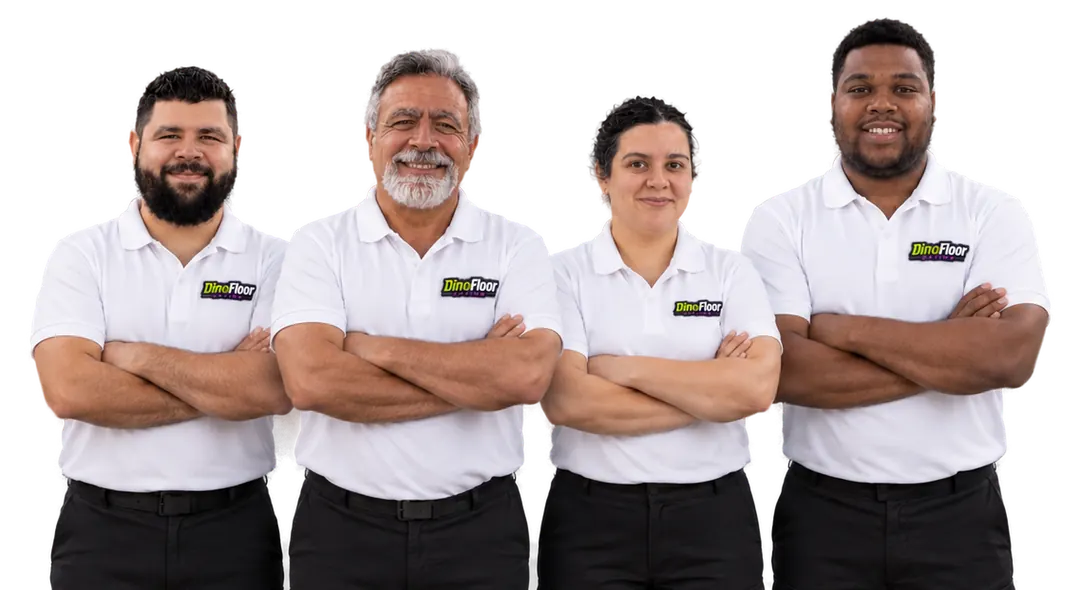
Eddie and his son Elias run every job the same way. The slab gets diamond ground back to open concrete, the cracks and pinholes get filled and leveled, and only then does any coating go down. Preparation is the part nobody sees and the only part that decides whether a floor is still tight years from now.
Want to know what your slab needs? Call Dinofloor Coatings and we will come take a look.
Why does epoxy stick when garage paint peels?
Because of what happens underneath it. Store bought garage paint rolls straight onto a smooth, troweled slab, so it only grabs the hard top skin of the concrete and nothing below it. The first hot tire that parks on it pulls it up in sheets. Epoxy bonds mechanically instead, which means the slab has to be opened up with a diamond grinder so the resin can soak into the pores and lock in. That grinding step is the backbone of every job our Menifee flooring contractor crew takes on. Do it properly and the coating has nothing smooth left to peel away from.
How do you prep a slab before the epoxy goes down?
In three passes. First we diamond grind the whole floor, corner to corner, until the smooth surface is gone and the concrete under it is open and dull. Then every crack, chip and pinhole gets filled and ground flat so the finished floor reads as one clean surface. Last, all the dust comes out, because resin bonds to concrete and it does not bond to grinding dust. The roughness we are after even has a scale: the International Concrete Repair Institute publishes concrete surface profiles that tell installers how open a slab needs to be for the system going on top of it. We grind to what the coating calls for, not to whatever the clock allows.
Turn that stained slab into a floor you show off
Diamond ground, crack filled and coated by Eddie and his family, right here in Menifee.
Call (714) 600-6609Which epoxy finish works best in a Menifee garage?
Most homeowners land on decorative flake. Colored chips get broadcast into the wet basecoat until the floor is full, then a clear topcoat locks them in, and the light texture hides the dust and tire marks a working garage collects. Quartz broadcast does the same job with graded quartz grain, which gives you more grip underfoot and a heavier build for a floor that takes a beating. Solid color is the simplest look, one flat shade wall to wall. Nearly every garage floor we install gets a polyaspartic topcoat over the epoxy, because polyaspartic cures fast, holds its color in the sun and takes the wear so the epoxy underneath does not have to.
Does an epoxy floor hold up to Inland Empire heat?
It holds up far better than the bare slab does. The heat problem on a garage floor is not really the air, it is hot tire pickup: tires come off the freeway soft and hot, park, cool down and grab whatever is stuck to the concrete. A thin coating lifts away with them. A properly ground and fully cured epoxy system with a polyaspartic topcoat does not, because the bond runs into the pores and the topcoat is built to take that abuse. Sun through an open door is the other one, which is why a topcoat that resists yellowing matters here. The same build goes down on the shop and warehouse floors we handle as commercial flooring in Menifee, where pallet jacks and forklifts are rougher on a floor than any car.
Ask a coatings guy
Straight answers to your floor coating questions
How long does an epoxy floor take to install?
Most residential floors are a one to two day job. Grinding and repairs take up the first stretch, the coating goes down after that, and the cure time between coats sets the rest of the schedule. We give you the plan for your slab before we start.
Can you epoxy a floor that already has paint or an old coating on it?
Usually yes. The old coating gets ground off first, all of it, because a new system is only ever as good as what it is stuck to. If the grinder turns up a problem in the slab underneath, we stop and tell you before we go further.
Will epoxy cover the cracks in my concrete?
We fill cracks and pinholes and grind them flat before coating, so they disappear into the finished floor. If a slab is actively moving, a coating cannot hold it together, and we will say so instead of hiding it.
How do you clean an epoxy floor?
A dust mop and a wet mop. The surface is sealed, so oil, brake fluid and spilled paint sit on top instead of soaking in. Wipe spills up when they happen and the floor looks the same for years.
Is an epoxy floor slippery when it gets wet?
A smooth topcoat can be. Flake and quartz finishes build texture into the surface, and we can add an anti slip additive to the topcoat if the floor sees water or you simply want more grip.
Do you install epoxy floors outside of garages?
Yes. We coat interior slabs, patios, shop floors and small commercial spaces around Menifee, Lake Elsinore, Murrieta, Corona, Riverside and Chino. We coat concrete, we do not pour it.